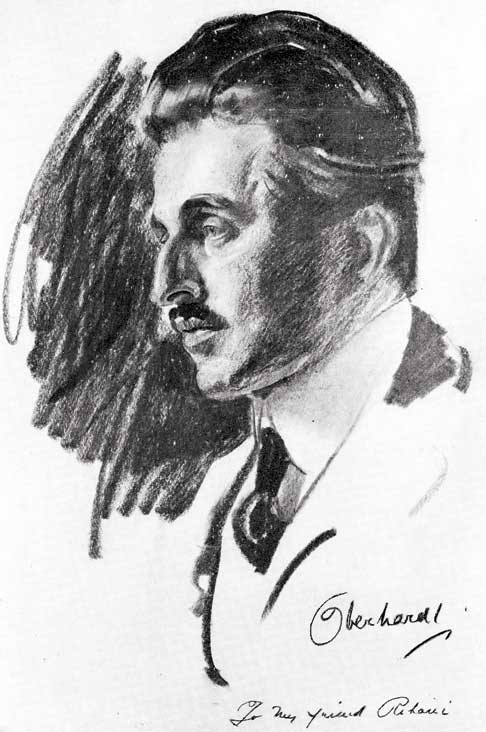
Ameen Rihani was an emigré Lebanese poet who wrote in English and Arabic. Like Kahlil Gibran and May Ziadeh, who were well known to him and his contemporaries, Rihani was one of the leading poets of the Arabic Renaissance (Nahda), particularly among the Mahjar poets – that is Arabic speaking poets who emigrated to the Americas.
They broke with traditional Arabic poetry – exploring new forms and new themes. Those new themes reflected their situation as exiles in a different world. Among them was a universal humanism, an example of which we see in Rihani’s poem below, which was part three of the poem “A Chant of Mystics“.* It is presented here with my Italian translation.
Apart from his success as a poet, Amin Rihani played a important role in May Ziadeh’s life. He was one of the leaders who campaigned to have her released from her unjust confinement in a mental assignment, raising the issue to the Lebanese parliament.
III
III
Yea, Man is as near the Beloved
As far from the world he may be;
He is full of the beauty of Allah
As he’s void of the Thou and the Me.
Life and the world we abandon
That the Life of the world we may see.
O, come to the assembly of Lovers
In the shade of the Tuba tree.
O, come to the Banquet of Union
And taste of the ecstasy.
O, come to the Tavern where nectar
And wine are a-flow as the sea.
For only the drunken are sober,
And only the fettered are free.
Sì, l’uomo è vicino all’Amato
Quanto distante dal mondo è;
È pieno della bellezza di Allah
Quanto vuoto di “Te” e “Me”.
Vita e mondo, li abbandoniamo
Così che la Vita del mondo potremo vedere.
O, venite all’assemblea degli Amanti
All’ombra dell’albero del paradiso.
O, venite al Banchetto dell’Unione
E assaggiate l’estasi.
O, venite alla taverna dove miele
E vino scorrono come il mare.
Poiché soli gli ubriachi sono sobri,
E solo gli incatenati sono liberi.
Like the waves of the ocean we rise and we melt into
foam
That the Moon’s caravan might carry us back to our
home.
Likes the motes in the sun-beam we dance in the dawn’s
disarray
That the sun might preserve us awhile from dust and
decay;
But the atoms of being, the motes in the Sun of his
Love,
Are aflame with desire to be where no night is nor day.
Like a child in the cradle whose mother must rock it
to sleep,
We rock to and fro that the child of our heart might
be still;
Like the lonely palm, when the whirlwinds over it
sweep,
We sigh and vvc chafe in our chains, and we bow to
his will.
Like the bird in the cage who pecks at his sugar and
sings,
So we, in the Cage of the world, to quiet our wings.
But the vulgar will say that the dance of the palm ’s
to the wind,
And the bird to the sugar is singing—Alas! for the
blind!
We come for their sake in the shape of a jar from the
Sea;
We are filled with the water that heals; and though
sealed, we are free.
Come le onde del mare ci alziamo e poi ci sciogliamo in
spuma
Così che la carovana della Luna ci potrebbe portare alla nostra
dimora.
Come granelli di polvere nel raggio di sole balliamo nello scompiglio
dell’alba
Affinché il sole ci preservi per un poco da polvere e
degrado;
Ma gli atomi dell’essere, i granelli nel Sole del suo
Amore,
Sono ardenti del desiderio di essere dove non c’è né notte né giorno.
Come un fanciullo nella culla la cui madre deve cullare per farlo
dormire,
Dondoliamo avanti e indietro così che il fanciullo del nostro cuore sia
fermo;
Come la palma sola, quando il vortice di vento la
travolge,
Sospiriamo e fremiamo nelle nostre catene, e ci inchiniamo alla
sua volontà.
Come l’uccello nella gabbia che becca lo zucchero e
canta,
Così siamo noi, nella gabbia del mondo, per quietare le nostre ali.
Ma i volgari diranno che il ballo della palma
è per il vento,
E che l’uccello allo zucchero canta — Ohimé! per i
ciechi!
Veniamo per loro in forma di vaso dal Mare;
E pieni di acqua che cura siamo; e anche se sigillato, liberi siamo.
Nor Crescent Nor Cross we adore;
Nor Budha nor Christ we implore;
Nor Muslem nor Jew we abhor:
We are free.
Né Croce né Mezzaluna adoriamo;
Né Buddha né Cristo imploriamo;
Né Musulmano né Giudeo odiamo:
Liberi siamo.
We are not of Iran or of Ind,
We are not of Arabia or Sind:
We are free.
Né dell’Iran né dell’Ind,
Né dell’Arabia né del Sind:
Liberi siamo.
We are not of the East or the West;
No boundaries exist in our breast:
We are free.
Né dell’Est né dell’Ovest;
Nei nostri cuori frontiere non si trovano:
Liberi siamo.
We are not made of dust or of dew;
We are not of the earth or the blue:
We are free.
Non siamo fatti di polvere né di rugiada;
Non siamo della terra né del blu:
Liberi siamo.
We are not wrought of fire or of foam;
Nor the sun nor the sea is our home;
Nor the angel our kin nor the gnome:
We are free.
Non siamo foggiati di fuoco o spuma;
Né sole né mare è nostra dimora;
Né angeli né gnomi abbiamo affini:
Liberi siamo.
Yea, beyond all the moons and the suns and the stars,
in a place
Where no shadow of horizon is, nor of darkness a
trace,
Where the Garden of God is a-bloom on Love’s radiant
strand,
There is our temple, our home, and our own native
land.
Yea, body and soul to the world and the sun do we
give,
And in the First Soul—the Soul of Beloved—eternally
live.
Già, oltre tutte le lune e soli e stelle,
in un luogo
Dove nessuna ombra di orizzonte si trova, né traccia di
buio,
Dove il Giardino di Dio è fiorente sulla riva splendente
d’Amore
Là è il nostro tempio, la nostra dimora, la nostra terra natia.
Già, corpo ed anima al mondo e al sole
diamo,
E nell’anima Prima – l’Anima dell’Amato – eternamente viviamo.
* A Chant of Mystics, appeared in a book under the name Ameen Rihani, A Chant of Mystics and Other Poems, (New York, James T. White & Co. 1921).
Image
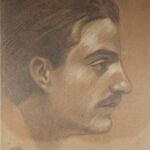
Ameen Rihani in 1921 – Portrait by American Artist William Oberhardt.