
-
Shakespeare, Sir Thomas More and the Strangers’ Case
Shakespeare writes about race. A lot. Othello and The Merchant of Venice are just the best known examples. Most regard Shakespeare’s writings as humanising the ‘other’ — the stranger among us. Yet his plays portray the kinds of prejudices and hatreds that today we call racism. His pen portrait of Iago, the villain in Othello, is a master pen portrait of the true ugliness of racism. A passage which is generally attributed to Shakespeare (see sources below) is perhaps the only substantial manuscript handwriting of the playwright which has survived until today. The passage appears in a play known as the Booke of Sir Thomas More. It is an Elizabethan…
-
No Human Being is Unclean
Bahá’u’lláh abolishes the concept of “uncleanness”. In different cultures, at different times, human beings and things have been held to be “unclean” – in the specific case of religion, “ritually unclean”. In 1873, Bahá’u’lláh wrote: God hath … abolished the concept of “uncleanness,” whereby divers things and peoples have been held to be impure.… Verily, all created things were immersed in the sea of purification when, on that first day of Riḍván, We shed upon the whole of creation the splendors of Our most excellent Names and Our most exalted Attributes.[1] Bahá’u’lláh’s purpose in doing so is suggested in the words that follow shortly after: Consort ye then with the followers of all…
-
Imagined foreignness
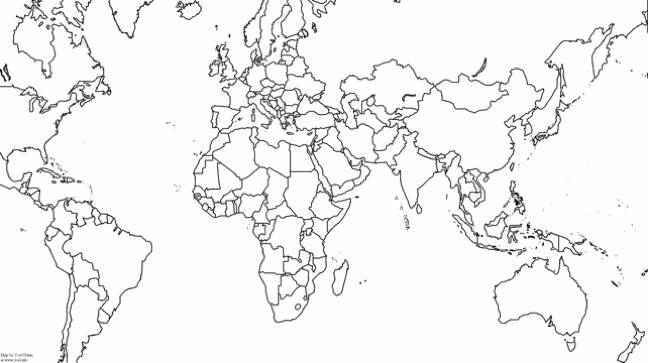
In our modern world, it is often the nation-state that acts as the locus from which conceptions of foreignness arise. It is to one (or more) of the 190-plus countries into which the globe has been carved up that we claim allegiance and tie our identities. Our passports, legal documents that represent our affiliation with a certain political establishment, act as reifications of our sense of belonging. We interpret the question “Where are you from?” as “Which country are you from?”, and we respond accordingly. And then, just as we use the country to which we belong as a means of identifying with people of the same nationality, we also…