-
Imagined foreignness
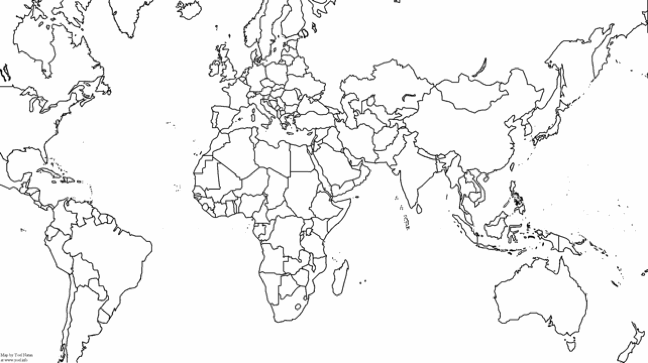
In our modern world, it is often the nation-state that acts as the locus from which conceptions of foreignness arise. It is to one (or more) of the 190-plus countries into which the globe has been carved up that we claim allegiance and tie our identities. Our passports, legal documents that represent our affiliation with a certain political establishment, act as reifications of our sense of belonging. We interpret the question “Where are you from?” as “Which country are you from?”, and we respond accordingly. And then, just as we use the country to which we belong as a means of identifying with people of the same nationality, we also…
-
UN High Commissioner for Human Rights in Australia
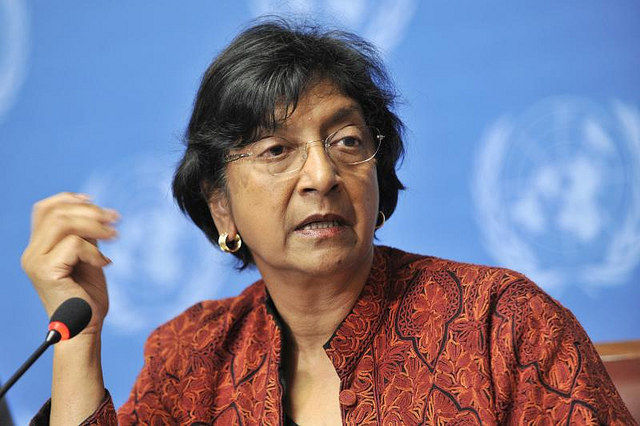
As, UN High Commissioner for Human Rights, Navi Pillay, today acknowledged there are a lot of human rights positives for Australia, but there were two issues on which Australia’s record is troubled: Australia’s treatment of indigenous Australians and asylum seekers. “In my discussions with Aboriginal people, I could sense the deep hurt and pain that they have suffered because of government policies that are imposed on them. I also saw Aboriginal people making great efforts to improve their communities, but noted that their efforts are often stifled by inappropriate and inflexible policies that fail to empower the most effective, local solutions. I would urge a fundamental rethink of the measures being…
-
Una visión de un mundo nuevo: Oración de Eleanor Roosevelt
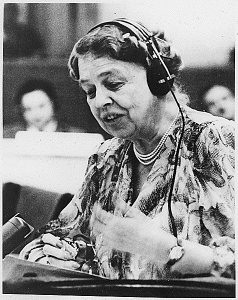
Eleanor Roosevelt fue el primer Presidente de las Comisión de Derechos Humanos de las Naciones Unidas. Su trabajo, con sus colegas, condujo a la adopción en 1948 de la Declaración Universal de los Derechos Humanos. A continuación, según su hijo, es una oración que decía cada noche: Padre nuestro, que ha creado una inquietud en nuestros corazones y nos hizo a todos los buscadores de lo que estamos plenamente nunca puede encontrar, nos permita estar satisfechos con lo que hacemos de la vida. Dibujar nosotros desde contenido de la base y fijar nuestros ojos en los objetivos de la medida. Nos mantienen en tareas muy difícil para nosotros que nos…
-
Foreignness: a primary problem
Image from freefoto.com One of the obstacles we face as a global society working to abolish foreignness is the perception of foreignness as only an ancillary problem, or a problem that is secondary to more critical and pressing global issues. Rather than deal with the question of the abolition of foreignness head-on, we seek to address the problem through proxies, hoping prejudice and hate and bias will simply go away if we first address the more material problems that supposedly underlie them. If we only do away with educational inequalities inner city schools, one argument might go, then racial tensions will be resolved. If we seek to address climate…
-
Australia Ratify Now: Migrant Workers Convention
One by one the world has adopted the major human rights treaties. Early on the general ones: the ones that said everyone has human rights. Then the treaties that tried to make this real for different groups in society. The ones that said we couldn’t discriminate on the basis of race, or against women, or commit torture, or violate the rights of children, or discriminate against disabled people. Just about every country has signed on to these treaties. There was one more major human rights treaty however: the 1990 International Convention on the Protection of All Migrant Workers and their Families. Unlike any of these other treaties not one single western or wealthy nation has ratified it. Countries…
-
Why Global Citizenship?
1. Introduction Plutarch said: … nature has given us no country as it has given us no house or field. … Socrates expressed it … when he said, he was not an Athenian or a Greek, but a citizen of the world (just as a man calls himself a citizen of Rhodes or Corinth).[1] Plutarch urged his audience to become conscious of a wider reality and to exercise their imagination to overcome a narrow, localised conception of their identity. That is the role of my global citizenship claim too. Plutarch and Socrates did not conceive of the world as a globe,[2] as I do: I have travelled across the world;…
-
Can we be foreign to our own selves?
It is a question with which we are forced to grapple these days. As shocking natural disasters rock the world, we look to each other, but we also look to ourselves, suddenly finding in our own lives transience and fragility. We consider anew what matters and what does not matter. We ponder and we question and we ponder some more, hoping for answers but wondering where they are within our own selves. And we wonder how well we even know ourselves. Of course, the question of who we are as individuals is hardly a recent one in our collective consciousness. Self-discovery is and always has been a recurring theme in…
-
Latest Deaths in Detention: Mohammed Asif Atay and Meqdad Hussein
Mohammed Asif Atay and Meqdad Hussein are the latest asylum seekers to die in Australian migration detention centres. Both were young men. Mohammed was aged 19. Meqdad was aged 20. Both were Hazara asylum seekers from Afghanistan. Both committed suicide. Mohammed had been detained for 10 months in the Curtin detention centre in South Australia. He had developed depression in the lead up to taking his own life. His death was reported on 29 March 2011. Meqdad was detained at the Scherger detention centre in North Queensland. Meqdad had recognised as a genuine refugee two or three months before his death. He lost hope when the Australian Security Intelligence Organisation issued an adverse security…
-
Libya’s Migrant Slaves
Among the tragedies befalling the people of Libya, is the tragedy befalling its migrant workers. On 9 March the International Federation of Red Cross and Red Crescent Societies reported that 30,000 migrant workers were forced back into Libya by forces loyal to Muammar Gaddafi to ‘return to work’ in Tripoli. This forced return amounts to slavery. It also violates international human rights in another way: Everyone has the right to leave any country … (article 14(2) Universal Declaration of Human Rights). Almost as soon as the uprising began in Libya the bonds that had held a multi-national community together fell apart. Although nationals and foreigners had lived together and shared their future before the uprising – after the uprising a person’s…