-
Australia seeks to process asylum seekers in East Timor
In a policy announcement echoing the discredited ‘Pacific solution’ of the previous Liberal Government, the new Australian government has decided to seek to detain asylum seekers in a ‘regional processing centre’ in East Timor. The new Australian policy reflects a general hardening of policies towards asylum seekers in the lead up to national elections. ABC news report ex-Amnesty International chief as saying that this policy will not work. The policy also reflects increasing practice engaged in by European nations of engaging third countries to prevent arrivals of asylum seekers and irregular migrants. A notable example is the detention in Libya of migrants seeking to reach Europe. The Global Detention Project…
-
Remote Control Borders: Violating Freedom of Movement
Article 13(2) of the Universal Declaration of Human Rights says that everyone has the right to leave any country. Increasingly countries are cooperating to violate this human rights by preventing aslyum seekers and others from leaving a country to seek refuge in another country. Some examples are: Egypt: which prevents Africans from leaving Egypt in attempting to enter Israel. On 11 June Reuters reported the killing of migrants on the Egyptian border, who were attempting to leave Egypt. 18 people have been killed this year so far, as compared to 19 for the whole of last year. http://www.alertnet.org/thenews/newsdesk/LDE65A0CZ.htm Indonesia: which cooperates with Australia to prevent asylum seekers leaving Indonesia to…
-
Abolish Foreignness
Eight million children under the age of five die each year from largely preventable causes. One billion people live in abject poverty. Thousands die crossing international borders while fleeing poverty, war or persecution. Rich countries reinforce barriers, laws and measures to prevent people crossing their borders. Hundreds of thousands are held in migration prisons as if they were criminals. 67 million people live as refugees or are internally displaced as a result of persecution, war, poverty or other causes. Believing that human beings are “foreigners” makes such profound human rights violations possible.
-
The Berlin Wall and Barack Obama
In recent days Germans and those affected by the Cold War are celebrating the 20th anniversary of the fall of the Berlin Wall. It is an anniversary worth celebrating. A chasm between the politics of the west and the communist world dissolved and people that had been kept apart for 40 years were suddenly able to come together. The process has not always been easy and far from perfect, particularly in respect of poverty. Nonetheless walls came down: literally and metaphorically. The White House press release on 6 November leading up to the event says little beyond congratulations: On the occasion of the 20th Anniversary of the fall…
-
Eleanor Roosevelt’s Prayer: A Vision of a World Made New
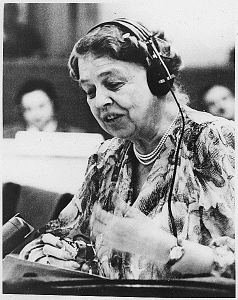
Eleanor Roosevelt was the first Chair of the United Nations Human Rights Commission. Her work, with her colleagues, led to the adoption in 1948 of the Universal Declaration of Human Rights. The following, according to her son, is a prayer that she said every night: Our Father, who has set a restlessness in our hearts and made us all seekers after that which we can never fully find, forbid us to be satisfied with what we make of life. Draw us from base content and set our eyes on far off goals. Keep us at tasks too hard for us that we may be driven to Thee for strength. Deliver…
-
Identity Crisis
Some countries obsess about ‘who we are’. The obsession becomes more intense, the more people with different coloured skins, different accents, diffent cultures become part of day to day life. In an age of migration “we” can become very confusing. Who can “we” be, if quite obviously “us” includes “them”. This question is not just one of tribalism, although tribalism is at the roots of this anxiety. The world is constructed around the idea of “races”: every nation a state and every state a nation. Italians in Italy, Germans in Germany, Poles in Poland. The theory was simple: better simplistic – and it never worked well. At its worst it…
-
The Borders of Science
Surely something as universally true as science could not have borders? Not in the twenty-first century. Not in the age of the internet. Like the refugees who face immense challenges in getting into Fortress Europe, getting the benefits of science to the poor in developing countries is incredibly difficult. The most well-known case was that of aids drugs and their availability to the poor in developing countries. The problem is this: the systems created to protect intellectual property simply ignores the existence of the poor who could never pay for drugs, priced at around US$17,000 for an annual supply. While developed countries were able to pay the price for aids drugs and…
-
Angelina Jolie and the Refugee Warehouses
What makes someone like Angelina Jolie take an interest in the lives of refugees? What makes anyone take interest? In this video Angelina visits refugees in Afghanistan. It’s clear that there is no “foreignness” in how she relates to them. She sees them as people who are suffering, and to whom we should respond.
-
Oppression of Women: Gender Apartheid
Full equality of men and women has not been achieved anywhere in the world. What has been achieved has taken a century and a half. In some parts of the world, women’s rights are so comprehensively denied that comparisons with apartheid are inadequate to capture the depth of deprivation.